Solutions · Overview
Solutions by ecosystem: KNX, Loxone, Crestron Home and Matter
Three wired ecosystems shape the residential market — KNX, Loxone and Crestron Home — plus Matter, which is not an installation system but a common language between platforms. 1Home connects to all three and exposes them to Matter and to voice assistants.
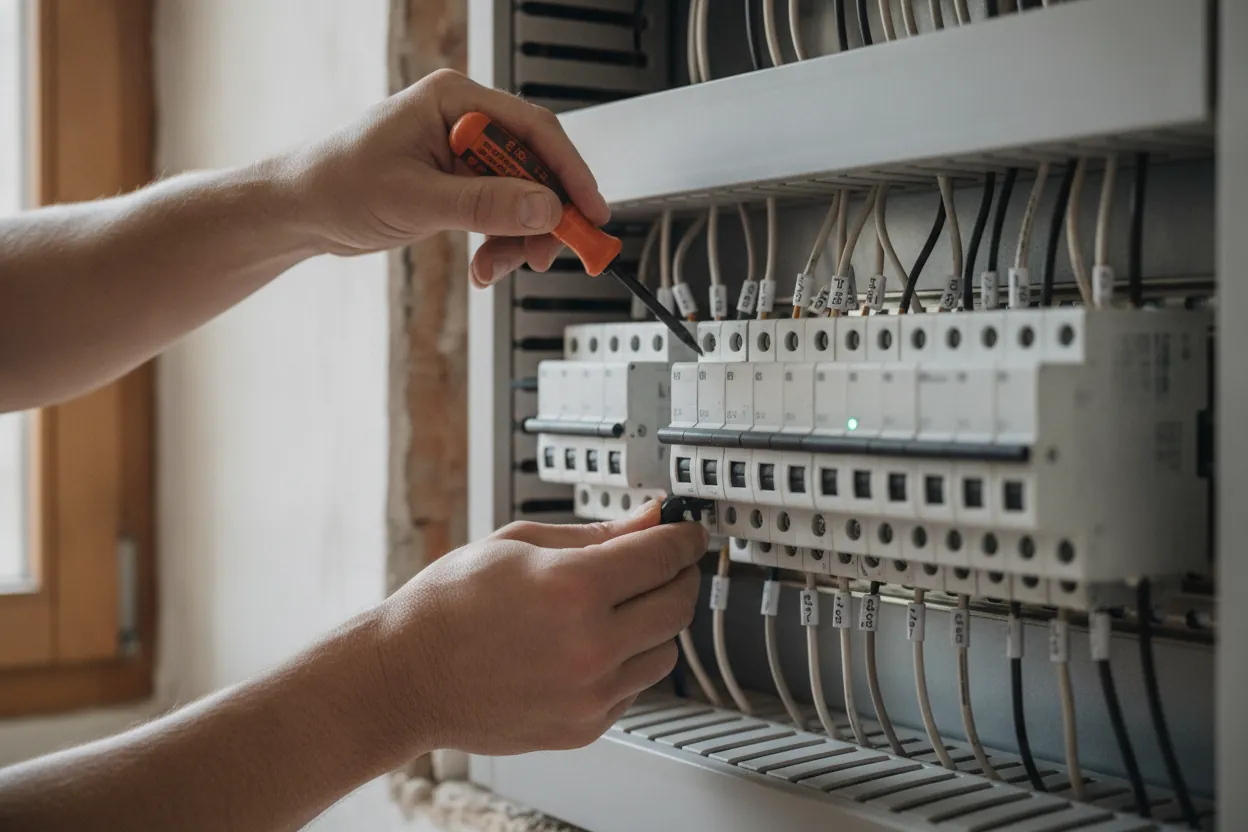
Before choosing a product you need to know what you are connecting to. A wired smart-home system is not a switch brand: it is an infrastructure — a bus, actuators in the distribution board, a programming logic — that decides what will be possible for the next fifteen years.
This page places the four worlds we serve and points you to the one that concerns you. If you already know what you have at home, go straight to 1Home for KNX, 1Home for Loxone or 1Home for Crestron Home.
01The three proprietary ecosystems and the Matter standard
All three systems below share one trait: the logic lives in the distribution board, not in a box sitting on a shelf. They differ in openness and in the installer profile they assume.
| Ecosystem | Nature | Programming | What 1Home adds |
|---|---|---|---|
| KNX | Open international standard (ISO/IEC 14543-3), multi-vendor | ETS (KNX Association software) | Visualisation, voice, remote access, Matter exposure |
| Loxone | Single-vendor integrated ecosystem around the Miniserver | Loxone Config | Voice and Matter exposure of the Miniserver |
| Crestron Home | High-end professional platform, certified dealers | Crestron tooling | KNX and Matter integration into the Crestron system |
| Matter | Interoperability standard (CSA), not a cabling system | None — it is a protocol | Bridge role: exposing the wired installation to Matter controllers |
02Wired or wireless: what it changes day to day
Wired systems respond in tens of milliseconds, depend on neither batteries nor a radio mesh, and keep working when the internet router goes down. In exchange they require a construction phase: conduits, a wider board, and a programming stage.
- Responsiveness: the command travels from the switch to the actuator without passing through a remote server.
- Autonomy: no batteries in wall controls, no range loss in a concrete house.
- Longevity: on KNX, a 2008 actuator still talks to a 2026 sensor — the standard is backwards compatible.
- Cost: wired systems are decided during structural work. In renovation, only as part of a heavy refurbishment or in hybrid form.
03New build, renovation or multi-dwelling?
New build
Everything is open. KNX to stay free of brand and integrator lock-in; Loxone for a coherent single-vendor system that is usually faster to commission; Crestron Home when the project already carries high-end distributed audio-video.
Renovation of an existing installation
The choice is already made: you keep the infrastructure and you open it. This is our most frequent case — a working KNX installation from the 2000s with no app and no voice control.
Multi-dwelling residential
The question is no longer comfort but operations: commissioning forty identical dwellings, then administering them. That is the ground covered by multi-site supervision.
04Where the 1Home gateway sits in each architecture
In all three cases the principle is identical: the wired system keeps control of the actuators, and the gateway simply makes it readable by the outside world — app, voice assistant, Matter controller.
- The wired installation keeps working exactly as before, even with the gateway unplugged.
- The gateway reads the structure of the installation and derives a list of controllable objects from it.
- Those objects are republished to the target platforms: the 1Home app, Apple Home, Google Home, Alexa, or Matter.
- Remote access goes through the manufacturer's service rather than an open port on your router.
Frequently asked questions
Can KNX and Matter coexist in the same house?
Yes, and it is the most common scenario: KNX carries the infrastructure, Matter acts as the shared interface to consumer platforms. The bridge translates; no KNX actuator is replaced.
Are Loxone and KNX compatible with each other?
A Loxone Miniserver can talk to a KNX bus through a dedicated extension, but the coexistence requires careful programming on both sides. In practice one system leads and the other becomes peripheral.